
“India’s Second Statement on Israel-Gaza War: A Delicate Balancing Act”
New Delhi: India said Thursday it had “always advocated… direct negotiations towards establishing… a sovereign, independent, and viable state of Palestine”. Foreign Ministry spokesperson Arindam Bagchi also said India is aware of a universal obligation to observe international humanitarian law.
Describing India’s position on the Palestine issue as “longstanding and consistent”, Mr Bagchi had said the government would like to see negotiations leading to a Palestine state “living within secure and recognised borders, side-by-side (and) at peace with Israel. That position remains the same.”
The government’s comments follow earlier statements offering unequivocal support for Israel and no mention of Palestine, which was criticised by opposition politicians and civil society activists.
In his first remark on the Hamas’ October 7 strike, Prime Minister Narendra Modi declared himself “deeply shocked” by the attack, which he swiftly identified as a “terrorist” action.
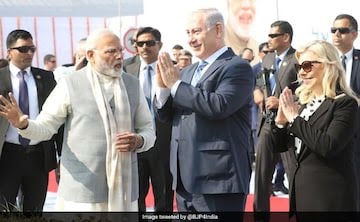
On Tuesday the Prime Minister spoke to his Israeli counterpart, Benjamin Netanyahu, on the phone, and said, “India stands firmly with Israel… strongly and unequivocally condemns terrorism…”
The two sets of comments are similar, in that both call out the global evil that is terrorism, but the emphasis this week on “a sovereign… and viable state of Palestine” has been seen as a significant opening of India’s position on the war, which broke as Delhi seeks a bigger Middle East role.
It has been seen as a recalibration of stances in light of Israel’s devastating response.
India’s initial response was seen as one dictated by both humanitarian concern for thousands killed or injured in Israel, and by growth of friendly ties under the Modi and Netanyahu governments.
However, as the situation evolves, and if Arab states that have so far been relatively quiet about the assault on Gaza start to speak up, Delhi may find itself in a difficult situation.
It has multiple strategic, economic and cultural interests with the Arab nations. And then there is oil; India imports the bulk of its oil from Iraq, Saudi Arabia and the United Arab Emirates. If this is stopped or reduced (for any reason), increased imports from Russia can offset some but not all.
India also has historically close ties with Palestine; in 1974 India was the first non-Arab state to recognise it as the “legitimate representative” of the Palestinians and, in 1988, as a full State.
Those ties have continued under the Modi government with the late Foreign Minister Sushma Swaraj visiting Palestine in 2016 and the then Palestinian President Mahmoud Abbas visiting India in 2017.
PM Modi returned Mr Abbas’ visit a year later, when he said India hoped to see an “independent Palestinian state living in an environment of peace”.
In fact, it isn’t just PM Modi’s BJP government that has called for “an independent state”.
In 1977, when the late former PM Atal Bihari Vajpayee, one of the BJP’s tallest leaders, said that for the Middle East issue to be resolved “Israel must vacate Palestinian land it has illegally occupied”.
That video re-emerged on social media this week as the Israel-Hamas hostilities escalated.
Credit to NDTV. Only Headline Modified: